
Yale Study: Medicare For All Saves Lives and Saves Money
Researchers say Senator Bernie Sanders' single-payer plan could save $1 trillion in health spending and prevent over 100,000 deaths
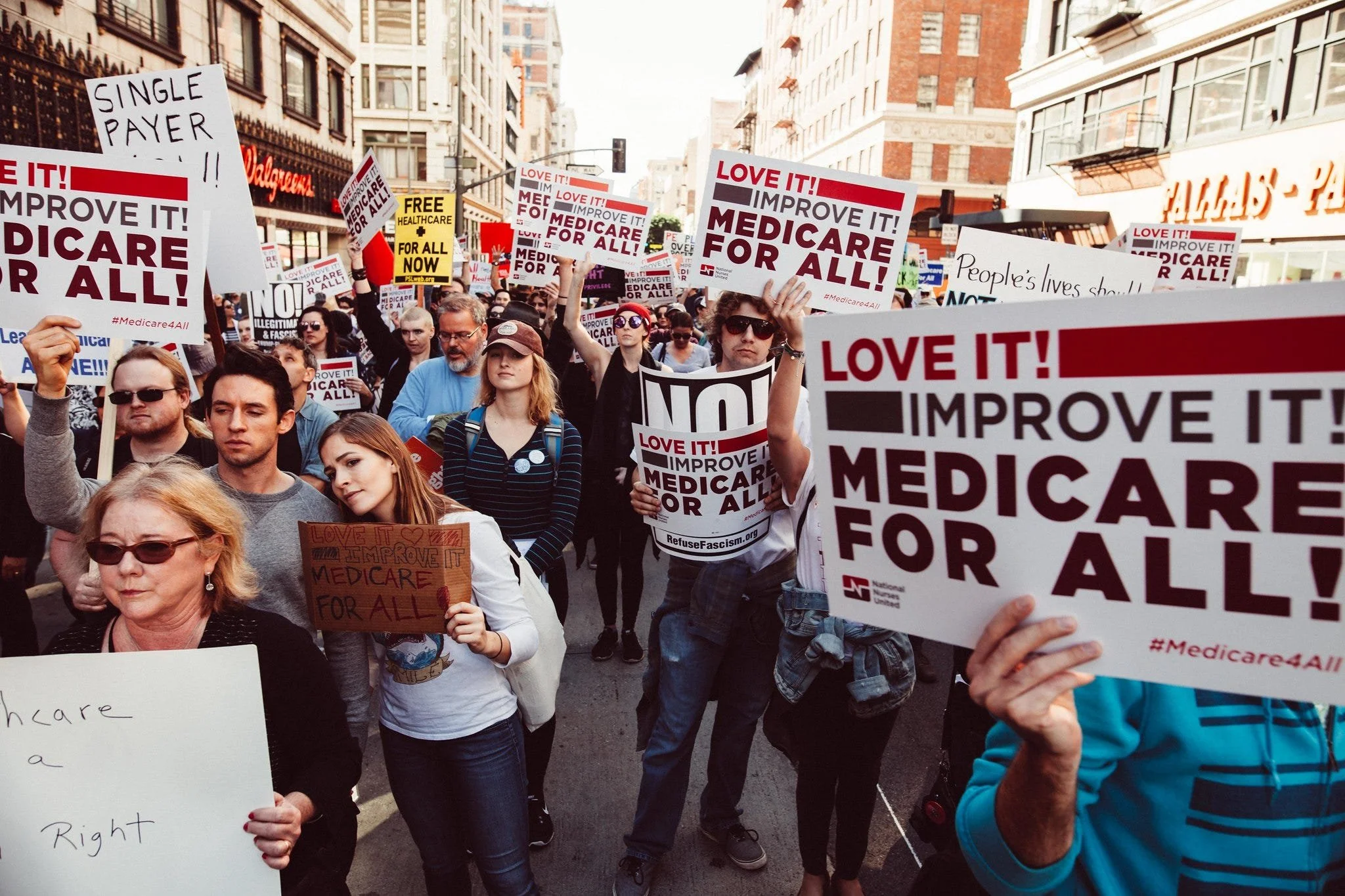
Photo by Molly Adams on Flickr
As private health insurance becomes prohibitively expensive for working families, and as over 15 million Americans are bracing to lose their coverage once Trump’s Medicaid cuts take effect next year, transitioning to a universal health care model has never been more important for saving money and, more importantly, saving lives.
Thankfully, a new study cited by Vermont Senator Bernie Sanders indicates a single-payer Medicare for All system is not only economically viable, but could save us over $1 trillion in annual health spending while improving the quality and access to care.
“We estimate that a single-payer universal health care system would reduce US national health expenditure by $1041.2 billion annually, or 19.7% of current spending, while saving 62,863 lives each year relative to the current system,” a group of five Yale University researchers wrote. “Our findings indicate that the principal barrier to universal coverage in the USA is not the absence of resources, but their allocation.”
And after factoring in more recent insurance coverage losses resulting from the Trump administration’s Medicaid and ACA cuts, the transition to a universal model could actually save as many as 114,174 lives, the researchers added.
According to a press release published by Senator Sanders’ office, the principal cost savings come from five primary sources:
$377.5 billion by paying no more than other countries for prescription drugs;
$286.3 billion by eliminating bureaucracy and waste;
$285.7 billion by curbing fraudulent billing;
$100 billion by preventing costly emergency room and hospital visits; and
$295.6 billion by reimbursing providers fairly for the care they provide.
“This study confirms what we have known for years: Medicare for All saves lives and saves money,” the Senator argued. “At a time when 15 million Americans are being thrown off the healthcare they have and 20 million Americans have already seen their premiums double, on average, as a result of Trump’s so-called ‘Big Beautiful Bill,’ we need Medicare for All now more than ever.”
Meanwhile, a consumer financial survey conducted by JG Wentworth exposed a disturbing trend unique to our flawed private system: the overwhelming majority of Americans are actively avoiding preventative care, fearing they can’t afford it. Young adults in particular, aged 18–28, are the most likely to avoid seeing a doctor because of cost, representing 94% of the demographic.
The consequences of skipped or postponed care cannot be overstated; according to a KFF survey, nearly two out of ten adults say their health worsened after avoiding treatment because of cost. This same phenomenon has bled over to prescriptions, where four out of ten adults say they aren’t taking their medicine as prescribed.
Moreover, delaying care and being unable to afford life-saving medications often result in costly and preventable trips to the emergency room, straining our public health infrastructure and leading to worse outcomes for patients.
This is one of the primary cost-saving opportunities behind Medicare for All, where illnesses can be caught and prevented early through inexpensive routine care instead of waiting for mundane symptoms to turn into life-threatening emergencies. Additionally, having a single government entity to negotiate drug prices would stop pharmaceutical companies from overcharging us for basic life-saving prescriptions such as insulin, saving billions of dollars by bringing costs in line with other developed nations.
Make no mistake, while Donald Trump and his sycophantic senators are actively making health care more expensive and less accessible for working Americans — with hospitals around the country already beginning to close their doors due to a lack of funding and insured patients — electing progressive leaders prepared to fight for Medicare for All has never been as important as it will be this November.
“It’s past time we fix our broken, profit-centered healthcare system that leaves many of us struggling to get care, and most of us struggling to pay for it when we go,” said Maine Democratic US Senate candidate Troy Jackson, as he decried the closure of local hospitals in his state last Friday. “We must pass Medicare for All.”
“What Medicare for All would be is guaranteed health insurance through the government without having to worry about a copay, a deductible, [or] a premium; it’s there from cradle to grave,” added Abdul El-Sayed, an epidemiologist and the Democratic US Senate nominee in Michigan. “You don’t lose it if you turn 26 or get married, get divorced, get a job, lose a job, [or] turn 65. And you don’t have to worry about being in network or out of network. You are covered. That security is something people across my state want so deeply.”
As the billionaire class and private insurance lobbyists inevitably ratchet up their attacks against universal healthcare — and pour millions of dollars directly into Republican senators’ pockets — we must remind ourselves of what we have to gain from Medicare for All, not what they have to lose.
As demonstrated by the Yale study’s findings, any cost to taxpayers will be more than offset by the $1 trillion in savings gained from eliminating the current system that prioritizes profit over people. Ultimately, Medicare for All will improve taxpayers’ financial security and make society healthier as a whole.
With the Trump administration spending billions of dollars per week to wage a pointless war in the Middle East, and even asking us to pay for the construction of his golden ballroom, there’s no question that universal health care would be a better use of public funds.
“A universal health care system in the US would not require the country to spend more on health care. It would require it to spend less,” Yale researchers concluded. “A system that covers everyone, costs $1 trillion less, and averts more than 100,000 deaths annually requires no new discovery to implement, only enactment.”
To read more, please follow us on Substack.
